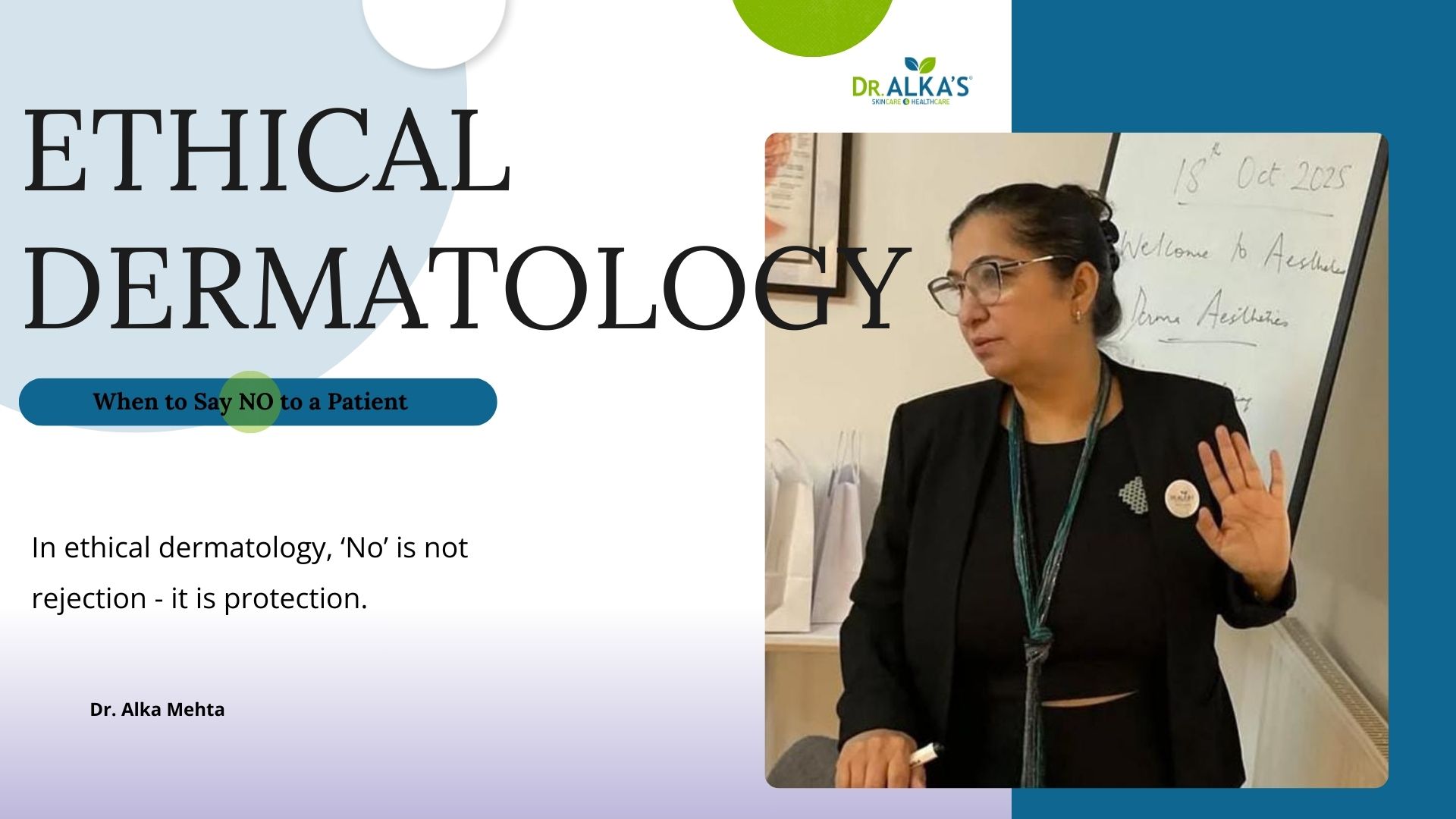
Ethical Dermatology: Learning When to Say No
By Dr. Alka Mehta
Founder, Dr Alka Skincare and Healthcare
There is a moment in every dermatologist’s career that no textbook prepares you for.
It is not the first surgery.
Not the first laser procedure.
Not even the first difficult diagnosis.
It is the first time a patient looks at you with expectation — and you realize the correct medical
answer is “no.”
Over the years in clinical practice, I have learned that dermatology is not only about improving
skin; it is about protecting it — sometimes even from the patient’s own urgency.
Skin is emotional tissue. It reflects stress, aging, hormones, lifestyle, and sometimes insecurity.
When someone asks for a quick solution, they are rarely just asking for a cream or a procedure.
They are asking for confidence, reassurance, or control.
But medicine is not magic. And ethical dermatology cannot be driven by demand alone.
I remember a young woman who came in wanting repeated chemical peels every week because
she believed faster peeling meant faster fairness. Her skin barrier was already compromised.
Red, sensitive, inflamed. Another peel would have given her short-term brightness — and long-
term damage. Saying yes would have pleased her instantly. Saying no meant disappointing her
temporarily but preserving her skin for years.
Ethics often feels uncomfortable in the short term.
Science teaches us that the skin barrier is not just cosmetic; it is immunological armor. Over-
exfoliation disrupts lipid balance, increases transepidermal water loss, and activates
inflammatory pathways. These changes are invisible at first — until pigmentation, sensitivity,
and chronic dermatitis appear. When I refused her request, it was not authority speaking. It was
physiology speaking.
There have been patients asking for permanent fairness, as if melanin were a flaw to erase rather
than a biological adaptation. Melanin is protective. It absorbs ultraviolet radiation, reduces DNA
damage, and lowers the risk of photoaging. To aggressively suppress it without indication is not
aesthetic medicine — it is interference with a protective system. In such situations, I gently
explain that dermatology enhances health; it does not fight biology.
Another difficult situation is when expectations exceed reality. A patient once wanted acne scars
removed in a single laser session before a wedding. I could have agreed, performed an
aggressive setting, and risked post-inflammatory hyperpigmentation. Instead, I explained
collagen remodeling is a gradual biological response. Fibroblasts require time to reorganize
extracellular matrix. Skin heals in phases — inflammation, proliferation, remodeling. Rushing
that process is like pulling at a healing wound.
When dermatologists say yes to everything, they may gain short-term satisfaction ratings. But
they risk long-term credibility.
There are also quieter cases — individuals distressed by barely visible imperfections. Sometimes
the skin concern is not dermatological but psychological. Performing procedures in such cases
may deepen dissatisfaction rather than resolve it. Ethical practice sometimes means pausing and
suggesting reflection rather than reaching for a syringe.
Saying no is not refusal of care. It is redirection toward safer care.
In medicine, we are guided by principles that may sound abstract but are deeply practical. Do
good. Do no harm. Act with integrity. These are not ceremonial words; they influence everyday
decisions in consultation rooms.
Patients often believe doctors enjoy refusing requests. The truth is quite the opposite. It is easier
to comply. It is harder to educate. It takes time to explain why viral skincare trends may
destabilize the microbiome or why steroid misuse can thin skin and cause rebound flare-ups. It
takes patience to describe why inflammation suppressed too aggressively can resurface more
fiercely.
But when patients understand the reasoning, trust grows.
I have found that most people accept “no” when it is delivered with transparency and
compassion. When they sense that the boundary is scientific, not financial. Protective, not
dismissive.
Ethical dermatology is not about restricting access to treatments. It is about aligning desire with
biology. It is about remembering that skin is living tissue governed by cellular behavior, not
social timelines.
At Dr Alka Skincare and Healthcare, our commitment has always been long-term skin health
over instant trends. A treatment delayed is sometimes a complication avoided. A procedure
refused is sometimes trust strengthened.
In the end, the word “no” in medicine carries quiet strength. It means the doctor is thinking
beyond today’s request. It means the skin’s future matters more than today’s impulse.
And in dermatology, protecting the future of the skin is the most ethical treatment of all.
—
Dr. Alka Mehta