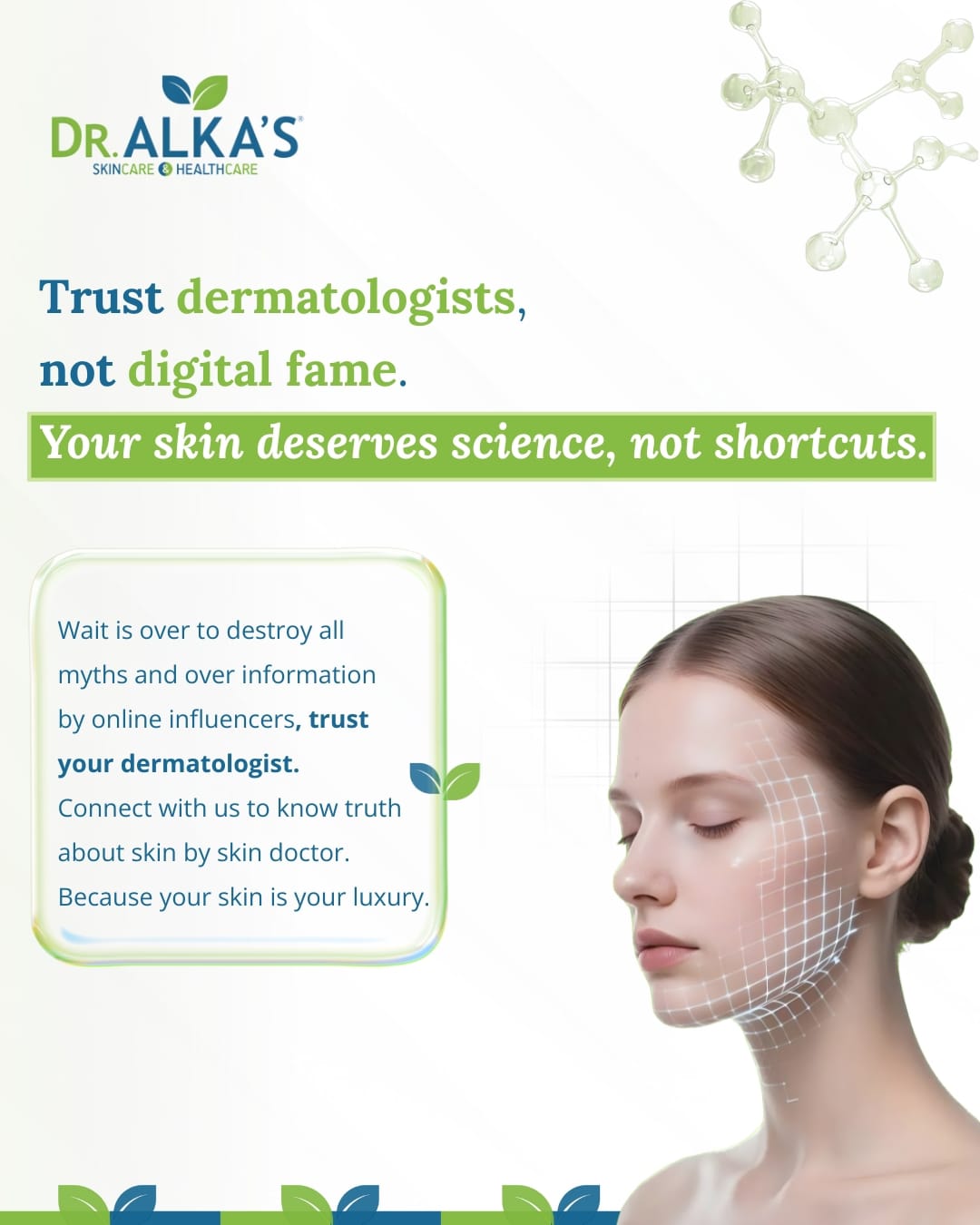
Dermatology vs Social Media Skincare: Why Healing Skin Requires Looking Beyond the Surface
Endorsed By Dr Alka Mehta MBBS, MD(Dermotology)
In today’s world, skincare advice is everywhere. A quick scroll offers routines, product
recommendations, before-and-after pictures, and confident opinions on what works and what
doesn’t. For many people, this abundance of information feels empowering at first — until
their skin doesn’t respond the way it was promised.
When patients come in after trying multiple online routines, they often say the same thing:
“I followed everything correctly, but my skin still isn’t better.”
The reason is rarely a lack of effort.
More often, it is because skin is being treated in isolation, instead of being understood as
part of a whole person.
This is where the difference between dermatology and social media skincare becomes
important.
Dermatology begins with a simple but essential question:
Why is this happening?
Without diagnosing the root cause , treatment becomes guesswork — and guesswork
damages skin.
Skin and hair concerns are rarely standalone. They are often influenced by hormones,
metabolism, stress, sleep, nutrition, and underlying medical conditions. An ethical, informed
dermatologist is trained to look beyond what is visible and understand what is driving the
condition internally.
Without this understanding, treatment becomes superficial — and frustration follows.
What is the root cause of this problem ?
Social media skincare often starts with assumptions:
- “If you have acne, use this.”
- “If you have pigmentation, apply that.”
- “If your skin is dull, exfoliate more.”
Without diagnosing the root cause , treatment becomes guesswork — and guesswork
damages skin.
Skin and hair concerns are rarely standalone. They are often influenced by hormones,
metabolism, stress, sleep, nutrition, and underlying medical conditions. An ethical, informed
dermatologist is trained to look beyond what is visible and understand what is driving the
condition internally.
Without this understanding, treatment becomes superficial — and frustration follows.
A very common example I see in my clinic is excessive hair growth in females.
Many patients come to me after undergoing 12 to 18 sessions of laser hair reduction, often
over several years, with negligible or temporary results. They are exhausted, disappointed,
and confused — because they were told laser is the solution.
The problem is not the laser itself.
The problem is that no one paused to ask where the excessive hair growth was coming
from.
In many women, excess hair growth is a sign of underlying hormonal imbalance, conditions
like PCOS, insulin resistance, or other endocrine issues. If these root causes are not identified
and addressed, laser alone becomes a repeated cosmetic intervention — not a treatment.
Without tackling the cause, laser can only offer partial or short-lived improvement. Over
time, this leads to more sessions, more expense, and more frustration — without real
resolution.
This is exactly why two patients with what appears to be the same concern cannot be treated
the same way. The same skin concern can have very different causes in different people.
Two individuals with acne may look similar on the outside, but one may be dealing with
hormonal imbalance while the other has barrier damage or chronic stress. Treating both with
the same routine is not just ineffective — it can sometimes worsen the condition.
Skin does not respond well to assumptions. It responds to understanding.
Social media skincare often overlooks this complexity. It focuses on visible problems and
visible solutions — what worked for someone else, what showed fast results, what looks
impressive on camera.
What it doesn’t show is the medical reasoning behind treatment choices.
It doesn’t show the internal evaluation, the hormonal work-up, or the lifestyle factors that
may be silently driving the condition.
Skin does not respond well to assumptions.
It responds to understanding.
Dermatology, by contrast, is not designed for instant results. It is designed for lasting skin
and hair health. That often means slower progress, realistic timelines, and a combination of
treatments — not just one procedure repeated endlessly.
It also means being honest with patients when a quick fix will not work.
An ethical dermatologist knows that healing cannot be rushed, and that doing more is not
always the same as doing what is right.
This approach requires restraint. A good dermatologist knows when not to treat, when to
pause, and when to say no. Not every concern needs a procedure. Not every request is
appropriate. Sometimes, protecting a patient means first investigating, then treating — even if
that delays visible change.
This may not be the most attractive approach on social media, but this is what I have been
following while treating my patients.
None of this means that social media skincare has no value. It can create awareness and
encourage people to seek help. But it should remain a starting point for questions, not a
substitute for diagnosis.
Learning online can be helpful.
Treating yourself online and just following trends is not helpful
The true difference between medical dermatology and social media skincare lies here:
one focuses on appearance, while the other focuses on healing.
An ethical, informed dermatologist looks at the person as a whole, identifies the root cause,
and works towards meaningful, sustainable improvement — not temporary fixes.
Because skin and hair health are not built through repetition of trends, but through
understanding, patience, and responsible medical care.
At DR Alka Skincare & Healthcare, this philosophy guides every consultation — to treat
thoughtfully, ethically, and with the patient’s long-term well-being at the centre.